
What axial length actually is
Axial length is the distance from the front of the eye to the back — essentially, how “long” the eyeball is. A typical adult eye measures about 23 to 24 millimeters. It sounds small, but changes of a fraction of a millimeter are exactly what we’re watching in myopia control.
Here’s the key insight most parents never hear: myopia progression is eye elongation. When a child becomes more nearsighted year after year, it’s because the eye is physically growing too long from front to back. The stronger the prescription, the longer the eye. So if we want to know whether myopia is truly getting worse — or truly being controlled — the most direct thing to measure is the length of the eye itself.
Why we don’t rely on the glasses prescription alone
The refraction — your child’s glasses prescription — is useful, but it’s a blunt tool for tracking progression. It can shift with focusing effort, fatigue, time of day, and small differences in how the measurement is taken. A child can appear “stable” on refraction while the eye is quietly still elongating, or look like they’ve jumped when they simply weren’t relaxed during the test.
Axial length has none of that noise. It’s an objective, physical measurement of the very thing that drives myopia. That makes it the gold standard for confirming a treatment is working — and for catching acceleration early, before it shows up as a big prescription jump.
Think of it like a child’s height chart. You wouldn’t track a child’s growth by guessing — you’d measure and plot it against the normal curve. Axial length lets us do exactly that for the eye, so we can see whether it’s growing normally or too fast.
How we measure it — quick and painless
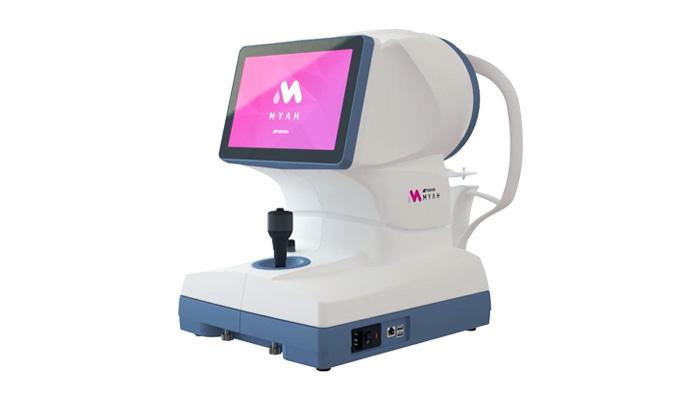
We measure axial length with optical biometry: a fast, non-contact scan that uses harmless light to measure the length of the eye in seconds. Nothing touches the eye, there’s no dilation required for the measurement, and it’s completely painless — easy even for young children. We record the result at each visit and plot it over time, building your child’s personal growth curve.
Why a longer eye is about more than thicker glasses
Slowing elongation isn’t about vanity or lens thickness — it’s about protecting long-term eye health. As the eye stretches, the retina at the back is pulled thinner, which raises the lifelong risk of sight-threatening conditions:
- Retinal detachment — risk rises sharply with higher myopia and greater axial length.
- Myopic maculopathy — damage to central vision that can’t be reversed.
- Glaucoma and early cataracts — both are more common in longer, more myopic eyes.
Every millimeter of elongation we prevent measurably lowers those risks decades down the road. That’s the real goal of myopia control — and axial length is how we measure our success at it.
How axial length guides your child’s treatment
Tracking axial length turns myopia management from guesswork into data-driven care. It tells Dr. Patel:
- Whether to start — fast elongation for a child’s age signals it’s time to begin treatment.
- Whether it’s working — a flattening growth curve confirms the current treatment is doing its job.
- Whether to adjust — if the eye keeps elongating, we can change the approach or combine treatments before progression compounds.
If you’re weighing your options, our guide to how we choose between Ortho-K, MiSight, Stellest, and atropine walks through each treatment — all of which we monitor with axial length.
Track your child’s myopia with real data
Book a myopia consultation and we’ll measure your child’s axial length, plot it against normal growth, and build a plan to protect their vision for life.
Frequently asked questions
References
Tideman JWL, et al. Association of axial length with risk of uncorrectable visual impairment. JAMA Ophthalmol. 2016. · Flitcroft DI. The complex interactions of retinal, optical and environmental factors in myopia aetiology. Prog Retin Eye Res. 2012. · Gordon-Shaag A, et al. Guidelines on myopia management and axial length monitoring. International Myopia Institute reports, 2019/2021. General ranges are approximate and vary by age, ethnicity, and individual.